
From the U.S. Wheat and Barley Scab Initiative FHB Tool Talk
Dear Extension Specialists, Crop Consultants, and Grower Organizations,
It’s time to start prepping for planting season. Winter wheat and barley are usually planted in the fall after the Hessian Fly free date. Here are some USWBSI approved planting tips to aid in managing Fusarium Head Blight (FHB) in your winter small grains next spring.
Tip #1: Seed selection may be the most important method of management.
When managing grain head diseases, such as FHB and the mycotoxins it produces, selecting a variety that is moderately resistant to FHB is crucial for preventing infection. Layering protection with a well-timed fungicide on top of a moderately resistant variety can provide up to 80% disease reduction, whereas using a fungicide without planting genetic resistance may only reduce FHB by about 50%. Agricultural land grant universities in many states conduct official variety trials and rate varietal resistance to FHB. Search your state’s land grant university websites for results to determine a variety’s level of resistance to FHB.
Tip #2: Thoroughly clean bin-run seed.
Some farmers may consider saving grain from the previous crop to use as seed for the following season. While this approach can reduce costs in the short term, it also increases the risk of exacerbating certain disease issues. If you choose to use stored seed, avoid lots that have not been thoroughly cleaned and those from fields with a history of FHB. If using bin-run seed, consider a fungicidal seed treatment which can be effective on Fusarium graminearum carried over on the seed coat, reducing stand and yield losses, and early-season diseases.
Tip #3: Residue management can impact disease management.
The state of the previous crop residue wheat and barley is sown into in the fall can have implications for disease management come spring time. Planting no-till into heavy or unevenly distributed residue can prevent uniform seed emergence, staggering head emergence, and thus flowering time. Farmers using no-till or reduced-tillage production systems are encouraged to choose a resistant variety when planting and to make sure residue is evenly distributed.
Tip #4: Crop rotation is crucial.
If at all possible, avoid planting winter wheat and barley following corn or other small grains as these are hosts for Fusarium graminearum, the causal agent of FHB. Crop residues can increase population levels of the fungus in the field and thus increase the risk of disease developing. It is advised to rotate production with non-host crops, such as soybean or alfalfa.
Thank you for reading! Feel free to forward this message to people in your community. Want to receive FHB Tool Talk e-newsletters? Subscribe today.
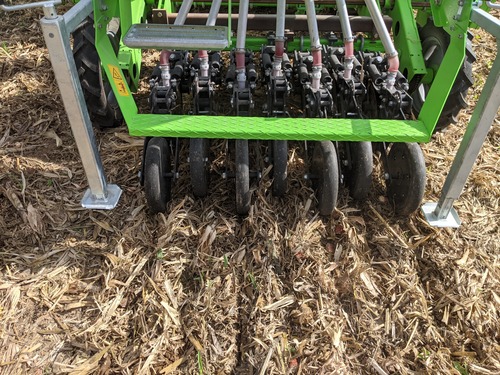
Wheat being planted into no-till corn residue in Kentucky. Photo credit: Carl Bradley, University of Kentucky.
|